
Working guide for real estate agents
What Is a Comparative Market Analysis (CMA)? A Practical Guide
A practical framework for turning scattered listing evidence into a pricing conversation your client can understand, review, and revisit.
Short definition
A comparative market analysis (CMA) is an agent-prepared evaluation that uses available evidence from similar properties to support a pricing or offer strategy. A sound CMA explains why each comparable was selected, distinguishes asking prices from verified sale data, and preserves the source and date of every material fact. It is not automatically the same as a formal appraisal, and local rules determine the professional requirements that apply.
01 — Scope
Start with the decision the CMA needs to support
A useful CMA does not begin by collecting as many properties as possible. It begins with a specific decision: setting a listing range, evaluating an offer, explaining a property's market position, or revisiting a strategy after conditions change.
Record the effective date, subject property, market area, intended audience, and limitations of the available data. This keeps an old screenshot or an unverified condition from being presented as a current fact.
- The decision and client question the analysis must address.
- The data cutoff date, currency, and market area.
- The defining characteristics of the subject property.
- Sources consulted and facts that still require verification.
02 — Selection
Choose comparables for similarity, not proximity alone
The sample must be defensible. A nearby property can still be a weak comparable when its type, condition, size, use, or transaction context differs materially from the subject.
Comparable location
Consider micro-market boundaries, access, surroundings, and local features that can change demand within the same neighborhood.
Comparable timing
Prioritize recent evidence and explain any market movement between the comparable's date and the CMA's effective date.
Comparable property
Review use, living area, room count, age, condition, layout, and the attributes that matter in the observed market.
Comparable evidence
Separate an active asking price, a reported pending transaction, and a verified closing price—they support different conclusions.
03 — Reading
Normalize the data before placing properties side by side
A clean table can still be misleading when similar-looking fields use different definitions. Preserve the original value and document every conversion or calculation so the reasoning can be reviewed later.
| Data point | What to clarify |
|---|---|
| List price and sale price | The first is an asking position; the second, when verified, describes a completed transaction. |
| Living area and total area | Do not mix measurement standards. State which area definition supports each price-per-unit figure. |
| Taxes, HOA fees, and recurring costs | Keep operating costs separate from price and note the period represented by each amount. |
| Status and effective date | An active listing can change or leave the market. Verify material facts before presenting the analysis. |
04 — Judgment
Explain adjustments instead of hiding judgment behind a number
No two properties are identical. If condition, view, parking, layout, or another feature changes your interpretation, name the difference and explain its direction. Avoid automatic percentages you cannot support with evidence from the market being analyzed.
Separate facts, professional inferences, and open questions. That distinction makes the recommendation easier to trust and easier to update when new information appears.
Transparency rule
Present an unconfirmed field as pending verification. Present a professional adjustment as judgment—not as mathematical certainty.
05 — Delivery
Finish with a recommendation that keeps the evidence attached
Your client should be able to understand what you compared, why you compared it, and what new evidence would cause the recommendation to change.
- A concise statement of the objective and recommended range or strategy.
- The subject property profile and the comparables included.
- A consistent table of prices, areas, dates, and relevant attributes.
- Explained differences, linked sources, and outstanding verification items.
- A recommended next step and a date for revisiting the analysis.
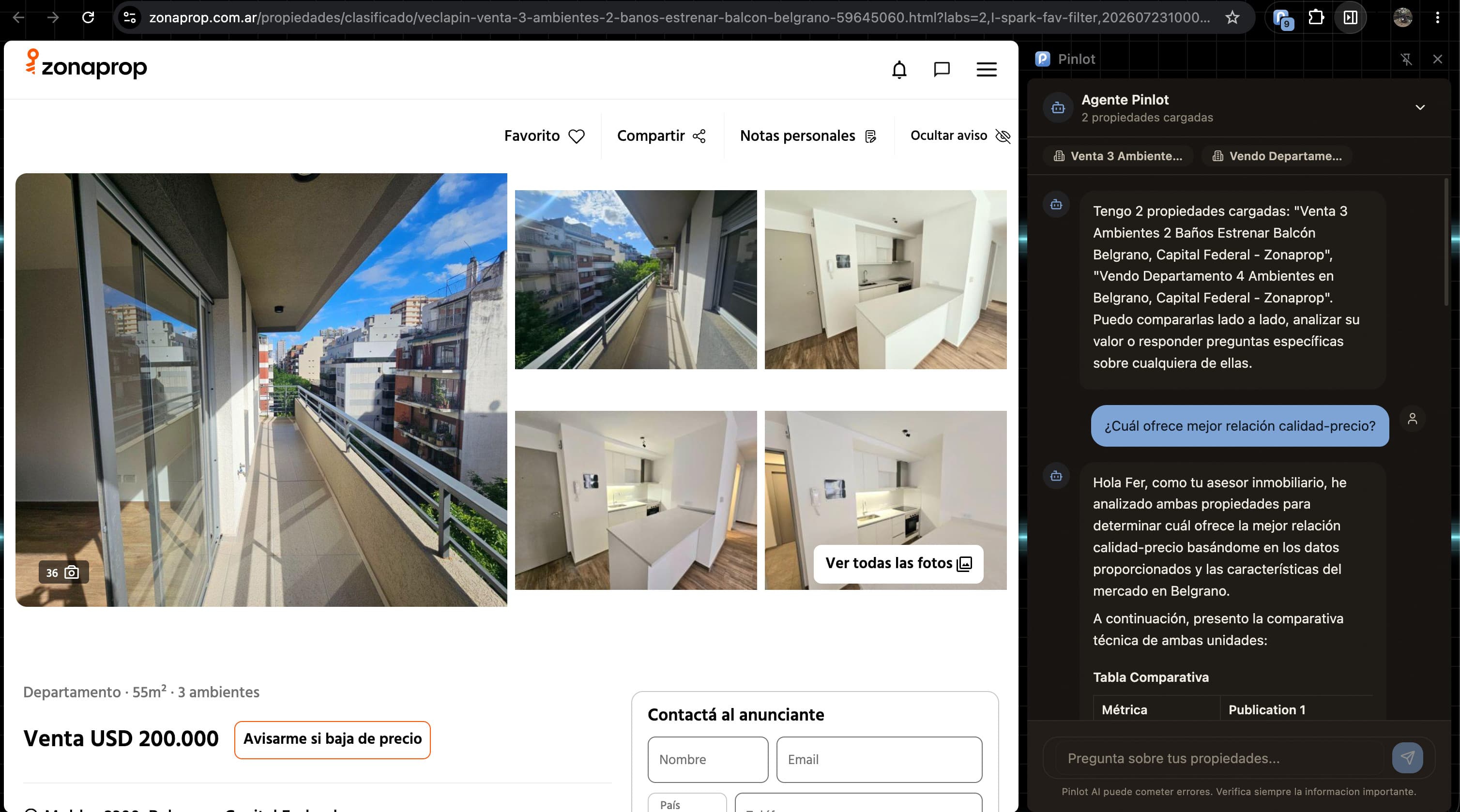
Where Pinlot fits
Every comparison keeps the listing that supplied the evidence.
Pinlot lets agents save listings from the browser, organize them by client project, compare selected properties, and turn the work into an editable, branded CMA report.
- Price, photos, property details, and source URL stay together.
- Selected comparables can be reviewed in one project context.
- The agent can edit and verify the analysis before sharing it.
Pinlot organizes evidence and assists the analysis. The real estate professional remains responsible for verification, judgment, and the requirements of the applicable market.
Frequently asked questions
Answers before you use the workflow.
How many comparables should a CMA include?+
There is no universal number. Use enough relevant evidence to explain the range, and exclude properties that add volume without meaningful similarity. The quality and traceability of the sample matter more than a fixed count.
Is a CMA the same as a professional appraisal?+
Not necessarily. A CMA is commonly used for real estate pricing and market strategy. A formal appraisal may require a defined scope, methodology, documentation, credentials, or responsibilities that vary by jurisdiction and purpose.
Can active listings be used as comparables?+
Yes, when they are clearly identified as active listings and used to understand current competition or positioning. An asking price is not equivalent to a verified closing price.
Can AI decide the final property value?+
No. AI can help organize, summarize, and identify differences in selected information. Source verification, professional judgment, and the final recommendation remain the agent's responsibility.
Keep exploring
Related resources
Apply the guide to a real search
Save the first property. Keep the reasoning attached to it.
Free to start · No credit card